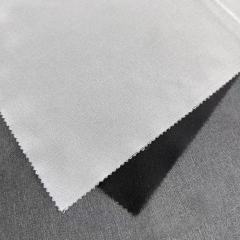
Thirty Grams for Light Woven and Knit Shells
How this article reaches that narrow figure matters more than the figure itself. A polyester web supplies the body, PES/PA hot melt supplies the bond, and close to four-fifths of the weight is therefore fabric. That is why a fused panel keeps its line without turning crisp or papery on a light shell.
The article sits in the middle of our standard lightweight band — above the 18.5 and 22.5 gsm codes, below the 45 gsm supports. In practice it lands on lightweight woven and knit shells: a poplin collar band, a viscose blouse cuff, a polo placket, the facing behind a soft jacket zip. Parts that have to stay put through pressing and laundering, on garments that should still move like cloth.
One distinction worth settling early: this is not a garment lining. A lining is a separate cloth sewn inside the finished garment and left to hang, while this article is fused to the reverse of the shell under heat and pressure, so support and shell behave as one piece from the press onward. Where a bill of materials lists both, they are two line items.
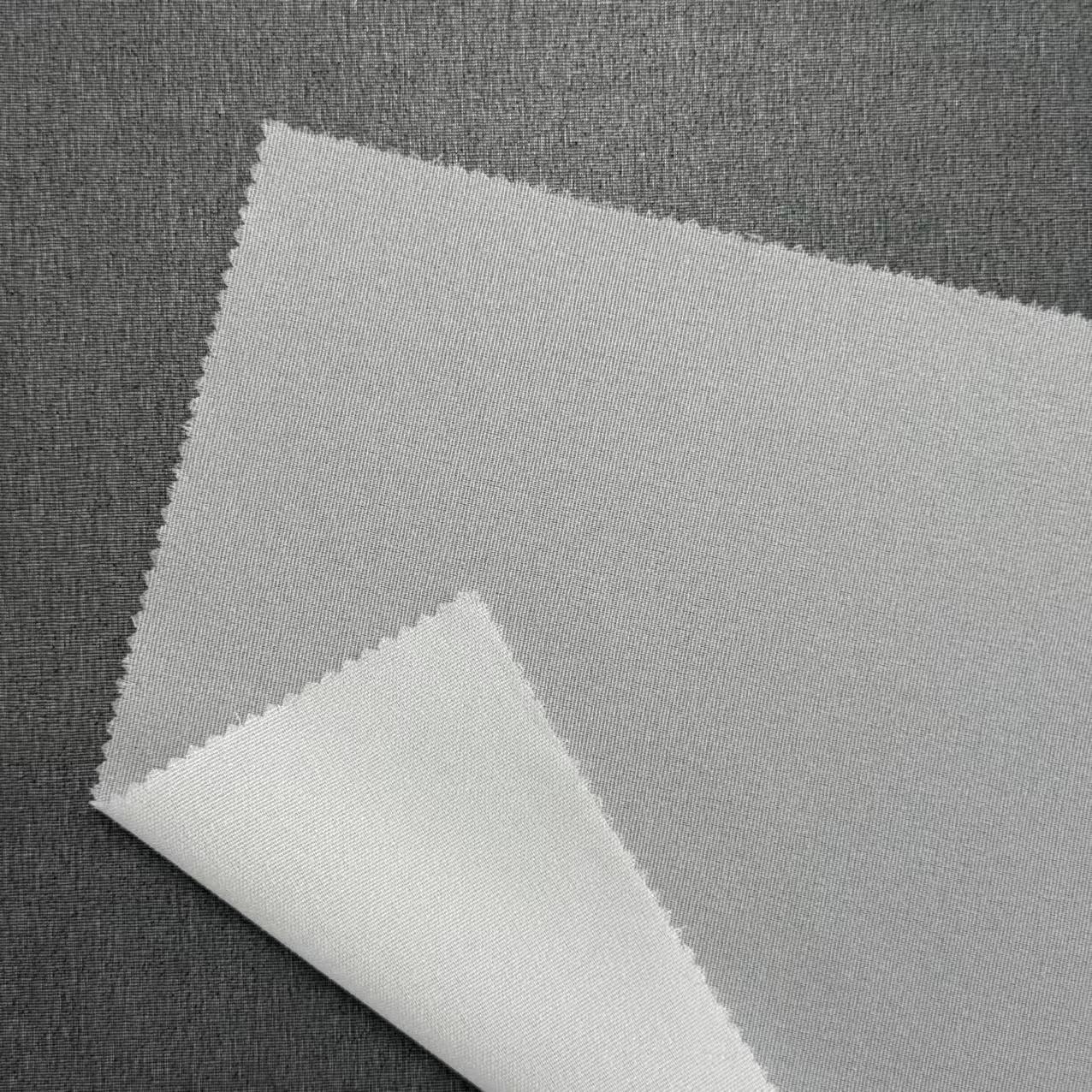
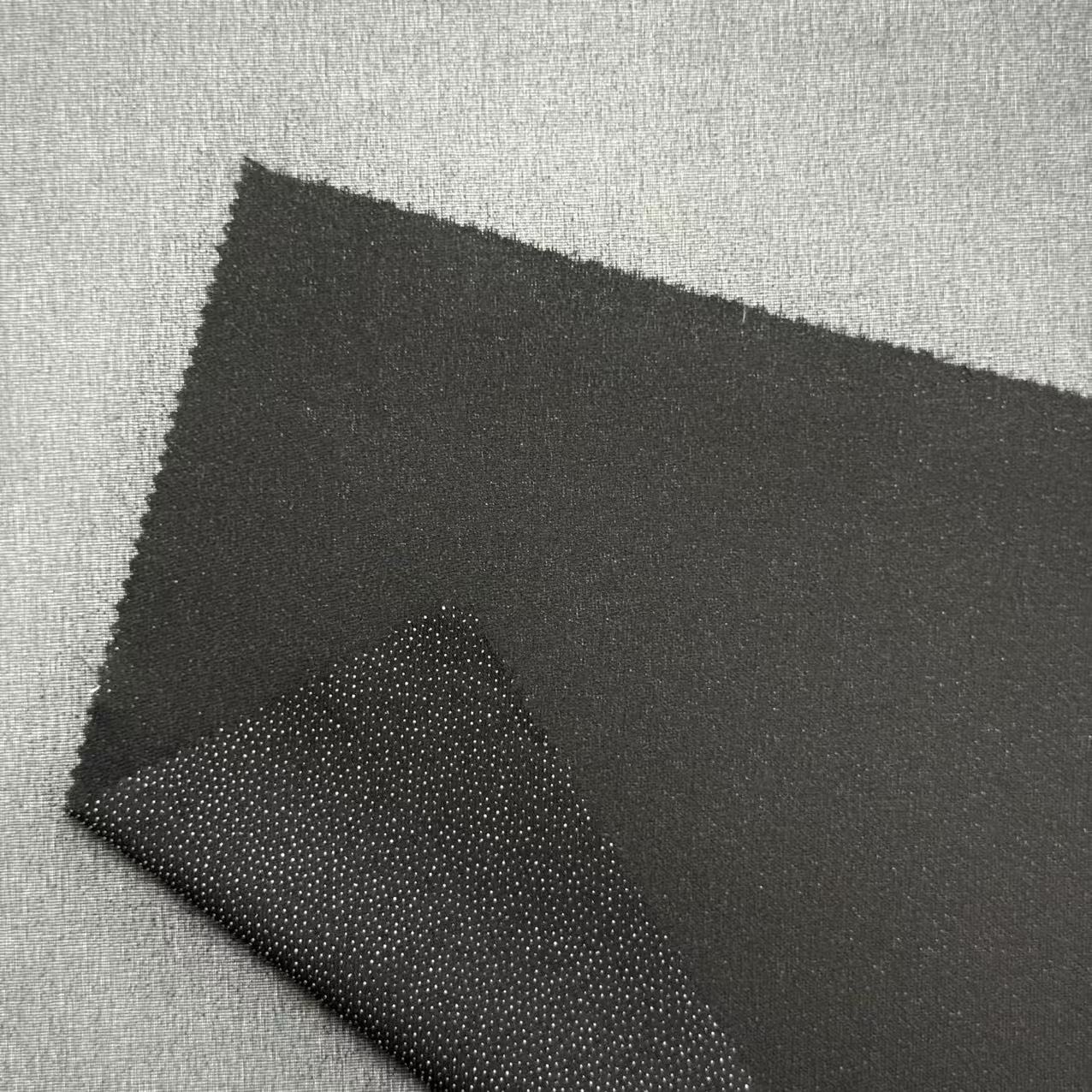
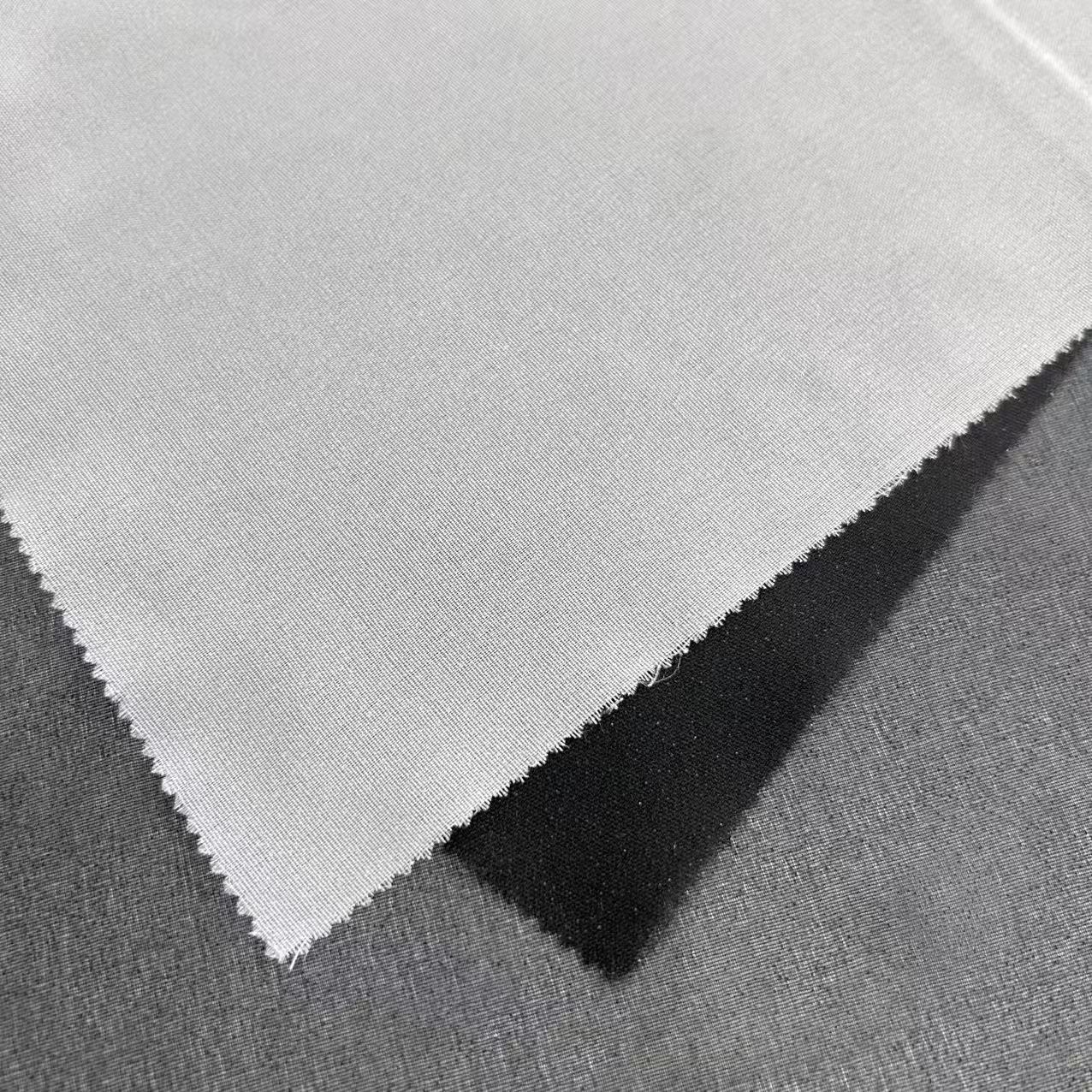
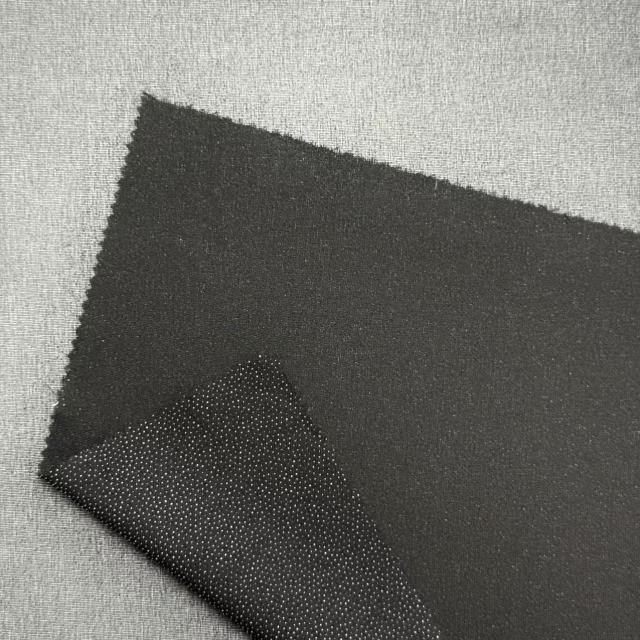
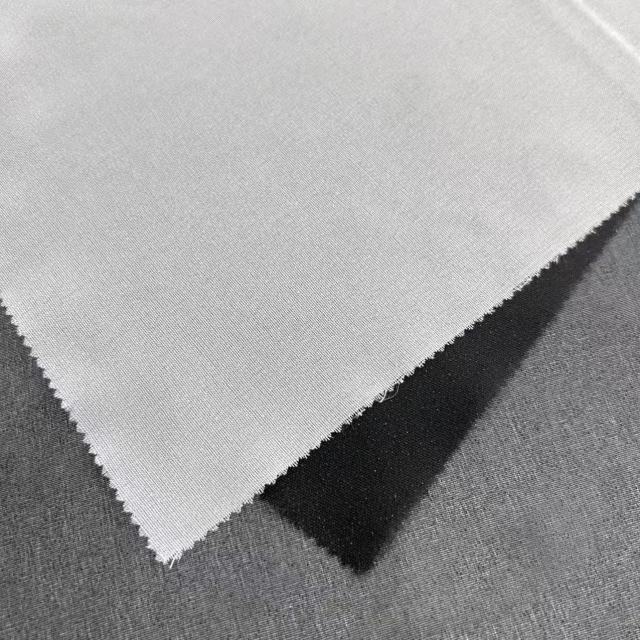
Five face and glue combinations run on the same build, including a black-glue version for thin dark shells where a pale adhesive dot would otherwise read through the face. Colour and glue are chosen together, not one after the other.
How the Web and the Glue Divide the Work
A water jet interlining is bonded rather than needled. Fine high-pressure jets entangle the polyester fibres into a flat, closed web with an even calliper from selvage to selvage — no needle lines, no chemical binder, no thick spots for adhesive to pool over. That evenness is set at the water jet interlining factory rather than at the press, and on a multi-layer lay it is what stops bond strength drifting across the panel.
The adhesive side is a paste-dot grid rather than a continuous film, and the dot pattern is visible on the back of the roll and on any cut swatch. Each dot is a controlled bond point; the gaps between them let the shell keep its breathability and its softness. On a 30 gsm article that balance is the whole trick, because 7 gsm of glue has to hold without dictating the hand.
PES/PA gives a wider bonding window than polyamide alone, which shows up on blended shells — polyester/rayon, polyester/cotton, resin-finished shirtings. If your line is written around a polyamide-only coating, the 33 gsm 3044-26 is the article to weigh against this one: same water-jet base, PA glue, one step heavier and a narrower colour set.
Put the two figures side by side and the behaviour follows. The 23 gsm web gives the fused part its shape; the 7 gsm coat holds it there. A heavier coat would bond faster and stiffen a light shell at the same time, and it is the usual cause of strike-through on fine pale fabric.
Setting the Fusing Window on Your Shell
- Cut from the shell itself, not from a shade card. Take a square of every shell lot and colourway in the programme, plus one full collar or cuff assembly with all its layers in place, because a setting proved on the body cloth does not transfer automatically to a facing.
- Record what goes into the trial: fibre content, weight, finish and dye lot of the shell, alongside the roll's own figures from the label. If a bond fails later, this sheet tells you whether the shell changed or the setting did.
- Check the press before blaming the material. Run a heat strip across the full working width, confirm the dwell repeats on a belt machine, and make sure the shell is dry — moisture left from steaming is a common source of bubbles that only appear after the final press.
- Start at the low end and step the temperature up. Too cold shows as a weak peel and edge lift after washing; too hot as glue strike-through, a pressed shine or a papery hand. The usable window sits between those two symptoms and is set on your equipment rather than quoted as a single figure.
- Judge the bond cold. A warm fuse reads stronger than it is, so let the sample rest, then peel a corner and look for fibre tear — glue pulling fibres out of the shell — rather than a clean release. Repeat on a sample that has been through your normal wash cycle.
- Look at the face as closely as the bond. Watch for dot show-through and glue grin on thin or dark shells, a ridge or shadow along the fused edge, and any shade shift under a pale ground; if a pale dot grid is visible through a dark shell, black glue is the fix on this article, not a heavier weight.
- Write the result down and keep the swatch. Temperature, pressure and dwell go onto the fusing card for that shell with the bonded sample beside it, so a new shell lot only needs steps 1 and 5 repeating.
Shell Checks Before Bulk Fusing
- Fibre content and blend. Get the exact composition of the shell you plan to fuse, not just its trade name — cotton poplin, polyester/rayon shirting, a polyester/cotton uniform cloth and a light jersey each carry the 7 gsm PES/PA coat differently. A polyester-rich shell and a cellulosic-rich one can both pass, but the peel strength behind them is not the same, and the difference only surfaces after washing.
- Finish route. Silicone softeners, water-repellent treatments, calendered surfaces and peach finishes are the usual reason a bond that passed the sample room lets go in bulk. Ask the finishing mill which route the lot you will actually cut has been through, and treat a change of finish as a new qualification even when the fibre content has not moved.
- Weight and cover of the shell. Note the shell's gsm and how open the weave or knit is. A very open construction gives the adhesive less continuous surface to grip, and a very dense calendered one gives it less to penetrate; either case is worth a bonded swatch before the order is fixed rather than after the first rolls are cut.
- Shade and lot reference. Lay the shell beside the roll face in daylight and note the shell's dye lot. Off-white, black yarn, dyed black and optical white are distinct faces on this article, and a warm off-white shell against a cool off-white roll still reads warm once fused.
- The care cycle the garment will carry. Confirm the wash temperature, drying method and any dry-clean step the finished garment will be labelled for, then run one bonded swatch through that cycle rather than a generic wash. A shell that shrinks or relaxes more than the interlining puckers along the fused edge, and no press setting corrects that afterwards.
- Lot control on the shell side. Qualify on shell from a single dye lot and reserve enough of that lot to cover the bulk run. Qualifying on one lot and producing from another is the most common way a proven setting fails on the floor.
- What to keep on file. Record the shell lot, its fibre and finish, the article and glue colour used, and the bonded swatch itself with the fusing card. Repeats are quoted against article 3013 and the shade, so this record is what settles any question raised by a later container of this water jet interlining, whether the run is a stock width or a custom water jet interlining order.
Fusing Comes Before Assembly
A jacket front or a shirt collar is fused flat, then handled, steamed and pressed several times before it is joined to anything else. That stretch between fusing and finishing is where a weak bond announces itself — a bubble at the pocket, a stretched panel at the lapel roll, a collar tip that has begun to lift. The 30 gsm build is aimed at the lighter end of that work: enough stability to keep a panel honest through shaping and pressing, not enough to turn a soft front into a stiff panel.
Sequence matters more than most buyers expect. The interlining is bonded to the shell first; the garment lining, where the style has one, is fitted afterwards as a separate operation. The fused panel therefore has to hold its own shape before a lining is ever sewn in, and it is bond strength plus dimensional stability, rather than softness on its own, that decides whether it does.
Care instructions sit behind the choice as well. Formal programmes usually carry a care label that puts the garment through repeated washing or dry cleaning, and a fused panel that deforms early fails the wearer long before a seam does. The PES/PA coat is there for that environment: the bond survives laundering and the panel keeps the silhouette it was pressed into.
On the floor the payoff is fewer structural pulls at finishing — fronts that stay flat, lapels that roll where they were pressed, and less rework after the final press.
Collar Stands, Cuffs and Front Panels
- Collar bands and stands. The classic use. Bonded rather than sewn into the band, so the inside face stays clean while the band holds itself upright and still curves around the neck without a hard line at the seam.
- Cuffs and plackets. Small, closely cut parts where an even calliper shows first: the fused piece presses flat, keeps its edge through repeated buttoning, and does not thicken the way a heavier support would.
- Front panels and facings. Panels that have to hold a line without stiffening the garment; the water-jet bonded web supports the shell while the drape stays with the cloth. The adhesive side faces inward, so against a garment lining the fused panel has to stay flat and soft rather than cupping away from it.
- Shirts, blouses and uniform tops. Rayon, polyester and blended shirtings are the everyday match, and the article runs in casual and formal programmes on the same reasoning.
- Knit polos and light jersey. Placket and collar support that still lets the knit stretch and recover, which a 45 gsm support would lock out.
- Sample room through to bulk. The salesman sample and the production run use the same article, so the hand feel signed off in the sample room is the one that ships.
- Where a heavier article does the work. A structured coat front, a heavy uniform or a jacket body needing real firmness asks for the 45 gsm and heavier supports in the range; 30 gsm is a light-shell weight and is not asked to do that job.
3013 Technical Data
| Property | Value |
|---|
| Article | 3013 |
| Composition | 100%Poly |
| Construction | Water Jet Interlining |
| Total weight | 30 gsm |
| Base fabric weight | 23 |
| Glue weight | 7 |
| Coating | 100% PES / 100% PA |
| Adhesive | Fusible, heat activated |
| Width | 60''/150CM |
| Colours | Off-white, black yarn, dyed black, optical white, black glue |
Ordering, Stock and Shipping
- Stock and shipping. Stock available; shipped by the container. The loading plan is agreed with our sales team when the order is placed.
- Slit to your marker. Custom water jet interlining orders are built around the widths your marker uses, with face colour and glue colour matched to the shell; send the width list and a shell swatch with the enquiry so the specification is fixed before the run is scheduled.
- Roll put-up and documents. Settle roll put-up, packing and the import paperwork at the same time as the order, so nothing holds the container at the port.
- Reordering. Quote article 3013 and the shade on every repeat; because it leaves a water jet interlining factory, the next container is coated and slit to the same figures as the one you qualified.
Scale & Supply Capability
We are a manufacturer rather than a trading company: production, quality control and stock sit under one roof, and we supply buyers worldwide — mostly converters, garment producers and trade partners who resell or specify our interlining into their own programmes. Fast-moving articles are kept in stock, so container-level repeat orders can be released without waiting on a fresh production run. Custom grammage, width and private-label packing are available on request, and we will help you match the right article to your shell fabric before you commit to bulk.
- One weight split, held to specification. The same total, base and glue weights apply on a stock roll and on a run slit to your marker, with no seasonal drift in the numbers. - Bond behaviour past the press. The fused panel is expected to keep its shape and its edge through laundering rather than puckering or lifting, which is the point at which a light interlining usually shows itself. - Hand feel kept deliberately light. The dot coat is thin by design, so the fused area still folds and drapes like the shell around it instead of reading as a laminated patch. - One build behind five colourways. All five come off the same construction, so a style running two shades stays one article rather than two. - Coating and slitting under our own roof. Because the web, the coat and the slit roll all come out of our water jet interlining factory, a repeat container is measured against the same standard as the first. - Figures recorded against the lot. Total weight and width are noted with each delivery, which is what a quality file tends to ask for first.
FAQ
Which fabrics is the 30 gsm weight meant for?
Lightweight woven and knit shells, chiefly: poplin and other cotton shirtings, rayon and viscose blends, polyester blends and light jerseys. It gives those fabrics enough body for a collar stand, a cuff or a placket without changing how the garment falls. A structured coat front or a heavy uniform is a different job and takes one of the heavier articles in the range — tell us the shell you are fusing and we will say which weight we would use on it.
How does 3013 differ from the 33 gsm 3044-26?
The glue system and one step of weight. 3013 is 30 gsm with a PES/PA coating and runs five face and glue options; 3044-26 is 33 gsm with a polyamide-only coating and a shorter colour list of off-white, dyed black and black glue. Where the shell bonds comfortably with a PES/PA hot melt, the wider colour choice usually settles it; where the line is already written around a polyamide glue, 3044-26 is the closer match.
Will the adhesive show through a dark or thin shell?
Not if the glue colour is matched to the face. The coating is a paste-dot grid rather than a full film, so there is far less surface to read through, but on a thin dark shell a pale dot can still catch the light — that is what the black-glue version is for. Fuse a piece of the actual shell and check it in daylight before the run is set, since the face, not the bond, is usually what decides the shade.
What width is it supplied in, and can it be slit?
Standard width is 60 in / 150 cm, which suits most cutting rooms without trimming. Narrower rolls can be slit to the marker for custom water jet interlining orders, and the width is recorded on the roll label against the lot. Send the width list with the enquiry so the slit sizes are fixed before the run is scheduled.
How does the bond behave after washing?
The fused panel is expected to keep its shape and its edge through laundering rather than puckering or lifting, which is the property this article is specified for and the reason 30 gsm is used on light shells that will be washed often. The shell is the variable: a finish that breaks down in the wash will take the bond with it, so confirm the care cycle the garment will carry and run one fused swatch through it.
What fusing temperature should I set?
There is no single figure for this article that holds for every press. The working window depends on the shell, the platen and the dwell, so it is established on your own equipment: begin at the low end of the range our sales team confirms for the PES/PA coat, raise it in steps, and judge the bond once the panel has cooled. Too cold shows as edge lift after washing; too hot as strike-through or a pressed shine.